Why Foster Youth Deserve More Than a Deadline
At eighteen, most young adults are just beginning to figure out who they are.
They may be graduating from high school, preparing for college, exploring career opportunities, or learning how to navigate independence.
For many, this transition happens gradually, with continued emotional, financial, and practical support from their families.
But for young people in foster care, adulthood has historically arrived with a very different set of expectations.
Imagine being told that because you have reached a certain birthday, the support system you have depended on is coming to an end.
No guarantee of stable housing. No family to turn to for financial assistance. No certainty about how you will continue your education.
For many former foster youth, this is not a hypothetical situation.
It was part of my own experience.
In October 2017, while pursuing my Master of Social Work at the University of Southern California, I wrote a policy advocacy paper examining California's efforts to improve the transition to adulthood for young people leaving foster care.
The assignment was more than an opportunity to analyze legislation.
It allowed me to connect my lived experience as a former foster youth with my developing understanding of social work, public policy, and the importance of advocating for systemic change.
It also led to a conversation with then-U.S. Representative Karen Bass, who had helped advance foster care reform in California.
That experience reinforced something I continue to believe: policies affecting vulnerable populations should never be developed without meaningful input from the people who have lived through those systems.
The Reality of Aging Out of Foster Care
The transition from adolescence into adulthood is a significant developmental period.
Young adults are often still developing financial independence, establishing supportive relationships, completing their education, and determining their long-term goals.
Although turning eighteen grants legal adulthood, it does not automatically provide the financial resources, emotional readiness, or practical skills necessary for independent living.
Historically, many young people in foster care were expected to become independent at eighteen, despite lacking the support networks that other young adults frequently rely upon.
This created substantial challenges.
Youth transitioning from foster care may face increased risks of housing instability, interrupted education, unemployment, and difficulties accessing healthcare and supportive services.
Importantly, these outcomes should not be interpreted as personal failures.
They often reflect the challenges of navigating adulthood without adequate resources, stable relationships, or continued institutional support.
From a social work perspective, this is why the person-in-environment approach is so important.
We cannot understand an individual's circumstances without examining the larger systems, policies, and social conditions influencing their opportunities.
For foster youth, the transition to adulthood is shaped not only by personal strengths and experiences but also by the support society chooses to provide.
California's AB 12: Recognizing That Adulthood Requires Support
In September 2010, California Governor Arnold Schwarzenegger signed Assembly Bill 12, also known as the California Fostering Connections to Success Act.
AB 12 represented a significant shift in how California approached the transition from foster care to adulthood.
Rather than requiring eligible young people to leave foster care at eighteen, the legislation established a framework allowing continued participation in extended foster care until age twenty-one, subject to eligibility requirements.
The policy recognized that young adults leaving foster care often require additional time and support to develop independent living skills.
Its goals included improving opportunities for education, employment preparation, stable housing, and meaningful relationships with supportive adults.
For many young people, these additional years could provide an important bridge between adolescence and independence.
However, when I examined the policy in 2017, I believed it did not go far enough.
Extending support to twenty-one was progress, but I questioned whether twenty-one was an appropriate endpoint for every young adult.
After all, many individuals are still completing college, pursuing vocational training, or establishing financial stability well into their twenties.
Why should young people who have experienced foster care be expected to achieve independence sooner than peers who continue receiving family support?
A birthday does not determine whether someone is ready to live independently.
When Support Ends Before You're Ready: My Experience
My perspective on this issue was shaped by more than academic research.
I entered foster care at approximately three years old and spent much of my childhood moving between placements.
By the time I transitioned out of the foster care system, I had experienced years of instability and separation from traditional family supports.
Like many young adults, I wanted to pursue higher education and create a stable future for myself.
Financial assistance through foster care-related programs helped me afford housing while attending college.
However, when I turned twenty-one, that assistance ended.
I was still working toward my bachelor's degree.
I was not financially independent, and I did not have a reliable family support system to help me navigate the sudden loss of resources.
I experienced homelessness and came close to dropping out of college.
At a time when I should have been focusing on my education and preparing for my future, I was struggling to meet my most basic needs.
In my original 2017 paper, I described feeling abandoned by a system that had been responsible for my care throughout much of my childhood.
That experience led me to question the expectations placed on foster youth.
If many young adults require ongoing support from their families well into their twenties, why should individuals leaving foster care be expected to navigate adulthood with fewer resources?
The issue was never simply about financial assistance.
It was about having the time, stability, and support necessary to transition into adulthood without being forced to choose between housing, food, and education.
Why Twenty-One May Not Be Enough
When I originally examined AB 12, I argued that foster youth should have access to continued support until at least age twenty-five.
My reasoning was grounded in both personal experience and the developmental challenges associated with emerging adulthood.
Between eighteen and twenty-five, young people may be completing their education, exploring careers, developing financial literacy, and forming relationships that provide emotional support.
For those who have experienced foster care, this period can involve additional challenges.
Some individuals are also navigating the effects of childhood trauma, disrupted attachment relationships, and instability associated with multiple placements.
These experiences do not mean that foster youth are incapable of independence.
Rather, they highlight why access to resources and supportive relationships can be especially important.
Independence should be something young people are supported in developing, not something imposed simply because they have reached a particular age.
Policies designed to assist transition-age foster youth should recognize that developmental timelines vary.
Some young people may be ready to live independently at eighteen.
Others may need additional support to complete educational goals, establish housing, or develop financial stability.
A responsive system should recognize those differences rather than rely exclusively on age-based deadlines.
My Conversation With Karen Bass: Why Lived Experience Belongs in Policymaking
One of the most meaningful experiences associated with my 2017 advocacy assignment was the opportunity to speak with then-U.S. Representative Karen Bass.
On October 6, 2017, I participated in a video conversation with Bass about foster care advocacy, public policy, and the importance of involving young people with lived experience in legislative decision-making.
Bass had been instrumental in advancing California foster care reform, including AB 12.
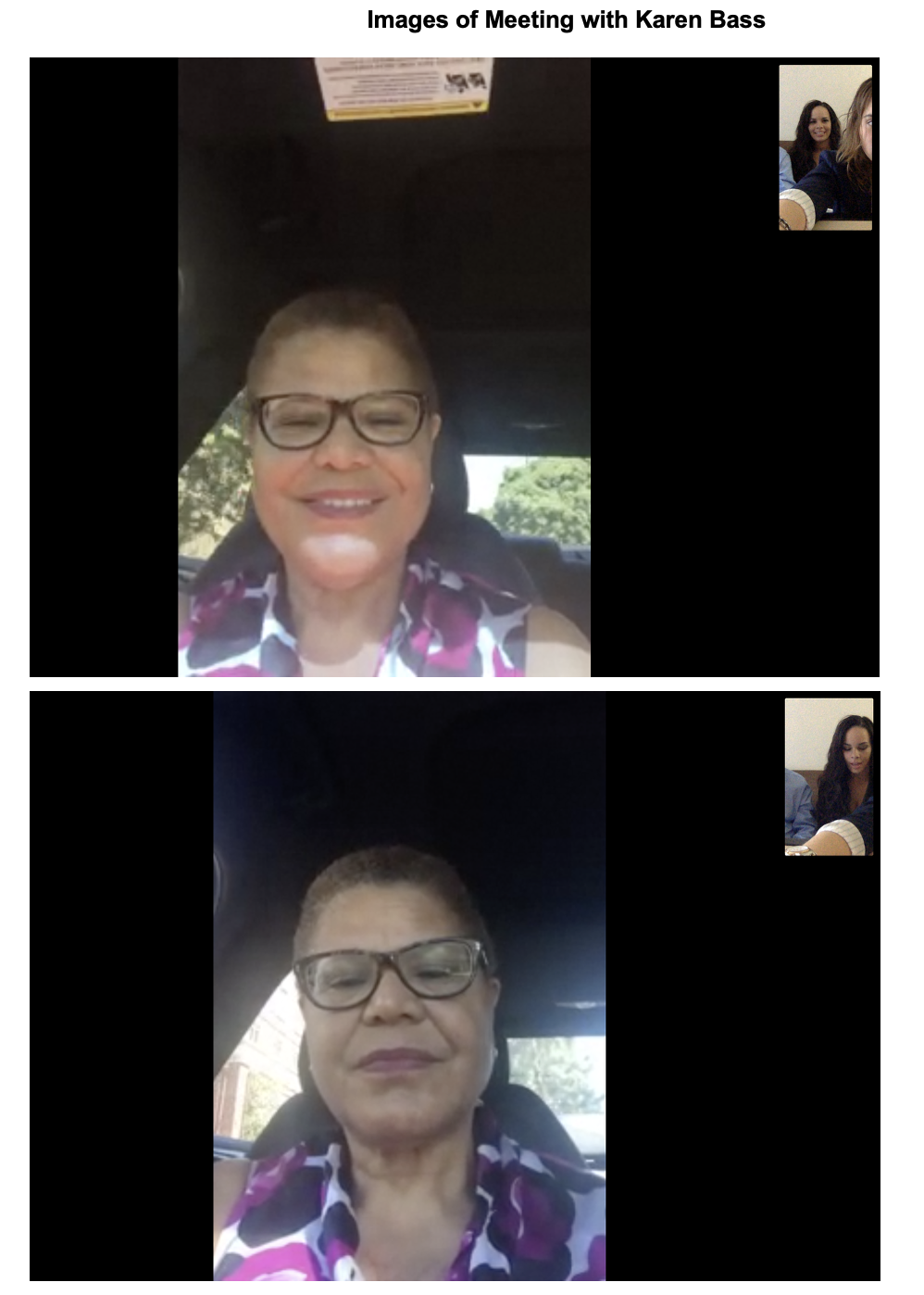
During our conversation, she discussed how her early advocacy work was influenced by families affected by the crack cocaine epidemic of the 1980s.
She described how children were being removed from their parents and placed with relatives, including grandparents, who often lacked adequate financial resources to support them.
This raised an important question about the way child welfare systems valued different caregiving arrangements.
Why should unrelated foster caregivers receive financial support while relatives caring for children may struggle to access comparable assistance?
Bass explained that helping grandparents organize and advocate for resources was an important part of her early community work.
Her experience illustrated how advocacy can begin at the local level and eventually influence broader political systems.
But one of the most important moments in our conversation centered on who should have a voice in creating foster care policy.
Bass emphasized that policymakers should not rely entirely on professionals and experts.
Young people who have experienced the foster care system must also be involved in identifying problems and developing solutions.
This perspective resonated deeply with me.
Professionals may understand research, legislation, and service delivery.
However, individuals with lived experience understand how those policies operate in everyday life.
They know what it feels like when financial assistance ends unexpectedly.
They understand the difficulties of navigating housing systems without family support.
And they can identify gaps that may not be immediately apparent to people who have never experienced foster care.
The conversation reinforced a central principle of effective advocacy:
People affected by policies should have meaningful opportunities to influence how those policies are developed and implemented.
Foster Youth Shadow Day: Creating Opportunities to Be Heard
During our interview, Bass also discussed Foster Youth Shadow Day, an initiative designed to connect young people with experience in foster care to members of Congress.
The program created opportunities for foster youth to visit Washington, D.C., engage with policymakers, and share their perspectives.
What made this initiative particularly meaningful was its recognition that young people are not simply recipients of services.
They are individuals with knowledge, experiences, and perspectives that can contribute to meaningful policy development.
This approach reflects the value of self-determination within social work.
Rather than assuming professionals always know what is best, social workers should recognize the expertise individuals bring through their lived experiences.
Foster youth should not have to wait until they become professionals, researchers, or policymakers to have their voices taken seriously.
Their experiences are relevant to policy discussions now.
Education Should Not Have an Expiration Date
Another important issue Bass discussed during our conversation was educational assistance for former foster youth.
At the time, she was advocating for changes to the Chafee Educational and Training Voucher Program, which provides educational assistance to eligible young people with foster care experience.
During our 2017 discussion, Bass questioned why educational support should be restricted by narrow age limits.
Not every young adult begins college immediately after high school.
Some may need additional time to secure housing, address financial challenges, or determine their educational goals.
Others may begin college but experience interruptions due to circumstances outside their control.
For foster youth, these challenges may be compounded by limited financial resources and the absence of family support.
Bass advocated for greater flexibility in educational assistance, recognizing that young people should have opportunities to pursue higher education even when their paths do not follow traditional timelines.
This issue was especially meaningful to me because of my own experience.
When I lost housing assistance at twenty-one, I was actively pursuing my education.
The loss of financial support threatened my ability to continue.
For students with limited resources, educational success can depend on more than academic ability or motivation.
Housing stability, financial assistance, supportive relationships, and access to basic necessities all influence whether students can complete their educational goals.
A system that encourages higher education must also consider whether students have the resources necessary to remain enrolled.
Why Advocacy Is a Social Work Responsibility
My conversation with Bass helped me better understand the relationship between direct social work practice and public policy.
Social workers frequently provide services to individuals experiencing financial hardship, trauma, housing instability, and barriers to educational opportunity.
However, many of these challenges are influenced by laws, policies, and institutional practices.
A social worker might help a young adult find temporary housing.
But what happens when there is insufficient affordable housing in the community?
A clinician might support a former foster youth experiencing anxiety related to financial insecurity.
But what happens when eligibility rules eliminate the assistance that helped the young person maintain stability?
Direct services can provide meaningful support, but they cannot independently resolve every structural problem.
This is why social workers must understand the interconnected nature of micro-, mezzo-, and macro-level practice.
At the micro level, social workers support individuals and families through counseling, case management, and resource coordination.
At the mezzo level, they work with organizations, groups, and communities to strengthen systems of support.
At the macro level, they advocate for policies, legislation, and institutional changes that influence access to opportunities and resources.
These levels of practice should not exist independently.
They are connected.
When social workers recognize patterns of unmet needs among clients, those observations can inform broader advocacy efforts.
Likewise, policy changes can create opportunities for more effective direct service interventions.
From Lived Experience to Professional Advocacy
Looking back on this assignment, I recognize how meaningful it was to examine foster care policy through both a personal and professional lens.
At the time, I was developing my identity as a social worker while continuing to make sense of experiences from my own childhood and transition into adulthood.
I understood what it meant to navigate the foster care system.
I understood the challenges of losing support before achieving financial independence.
And I understood how difficult it could be to pursue educational goals while experiencing housing instability.
What I was beginning to understand more deeply was how those experiences connected to public policy.
My challenges had not existed independently of larger systems.
They were influenced by eligibility requirements, funding decisions, and policies determining when young adults could receive assistance.
This realization strengthened my belief that social workers have a responsibility to advocate beyond the individual level.
It also demonstrated the importance of including lived experience in professional conversations about social justice.
Research provides valuable information.
Clinical expertise is essential.
But neither should replace the voices of the people most directly affected by the systems we seek to improve.
Final Reflections: Foster Youth Deserve More Than Survival
When I wrote my original advocacy paper in 2017, I argued that young people leaving foster care deserved greater support during their transition into adulthood.
That belief remains central to the message of this reflection.
Foster youth deserve opportunities to pursue education, establish meaningful relationships, develop financial stability, and build lives that reflect their goals and aspirations.
They deserve access to supportive adults who can offer guidance during difficult transitions.
And they deserve policies that recognize the complexities of growing into adulthood.
Extending foster care support to age twenty-one represented an important policy development.
However, the broader question remains:
Are we creating systems that genuinely prepare young people for independence, or are we simply moving the deadline at which assistance ends?
Meaningful reform requires listening to former foster youth, examining the long-term consequences of policy decisions, and recognizing that successful transitions into adulthood require more than temporary assistance.
As both a former foster youth and a social worker, I believe our responsibility extends beyond helping young people survive the transition out of care.
We should be creating systems that give them meaningful opportunities to thrive.
Because every young person deserves more than a deadline.
They deserve a future.
Author's Note: This article is adapted from a policy advocacy paper I completed on October 26, 2017, while pursuing my Master of Social Work at the University of Southern California. It includes reflections on my experiences as a former foster youth and a conversation with then-U.S. Representative Karen Bass on October 6, 2017. Legislative details and advocacy efforts discussed reflect the historical context of the original assignment. Foster care and educational assistance policies have evolved since that time.
Reflection Question: How can child welfare systems better support young adults as they transition from foster care into independence?
