Module 1: Introduction to the Brain and Behavior
Meet Your Students' Brains: An Introduction to the Brain and Behavior
Welcome to This Lesson
If you've ever had a student who seemed to "shut down" when corrected, or who overreacted to something that seemed minor, you've already witnessed the brain in action.
Understanding what's happening beneath the surface, neurologically, can completely change how you see and respond to your students.
Learning Objectives
By the end of this lesson, you will be able to:
Identify the two main brain regions involved in emotional behavior and decision-making
Explain in simple terms what the amygdala and prefrontal cortex do
Describe how these two regions communicate and why that matters for students
Begin connecting brain function to what you observe in your classroom every day


What this looks like in your classroom:
A student who becomes aggressive or shuts down when corrected
A student who seems "on edge" or easily startled
A student who overreacts to situations that seem minor to you
The Amygdala: Your Brain's Alarm System
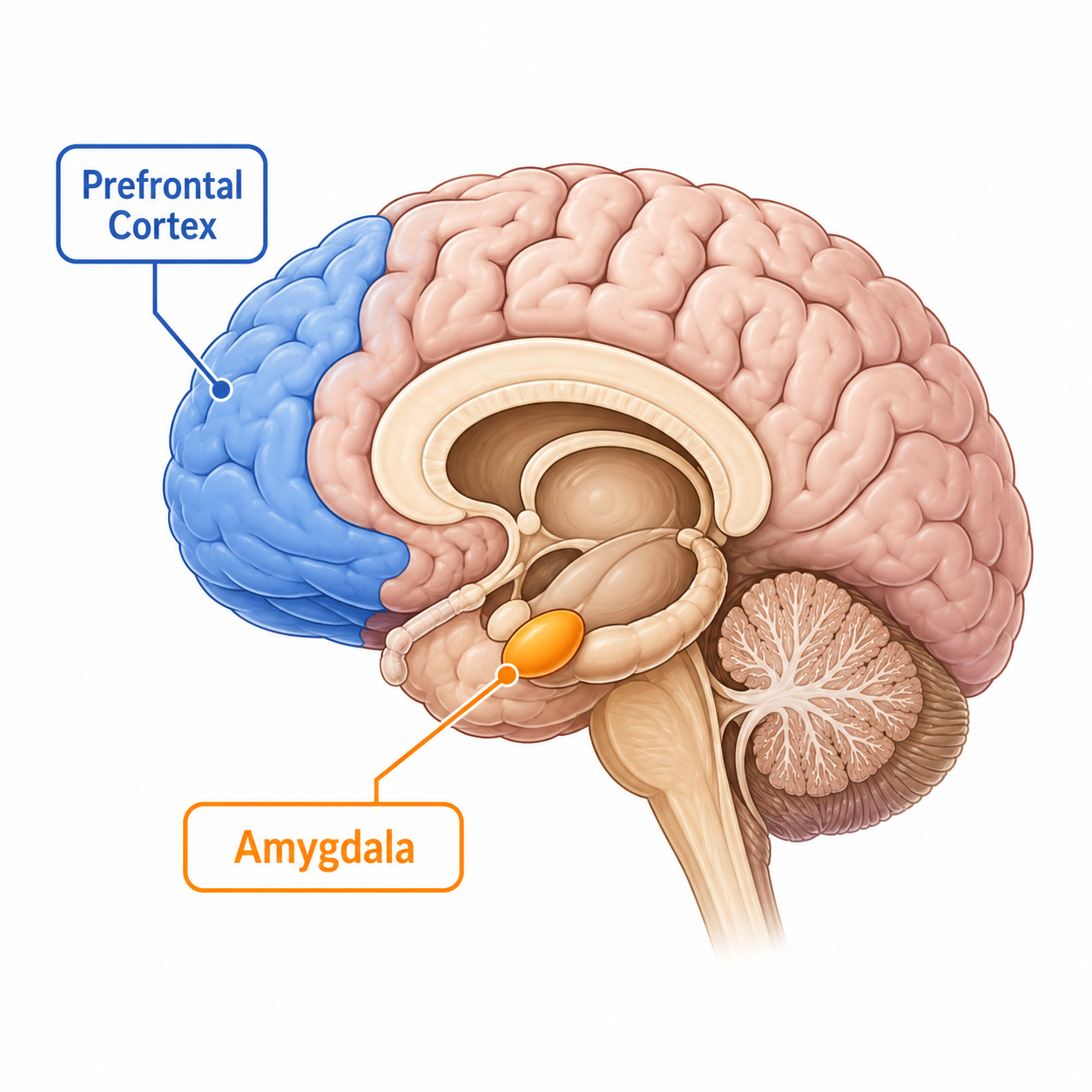
The amygdala is a small, almond-shaped structure deep inside the brain, and it has one very important job: keeping you safe. It is your brain's built-in alarm system.
When the amygdala detects something it perceives as a threat, whether that's a loud noise, an angry voice, or even a look from a teacher, it sounds the alarm and prepares the body to respond. This is where the well-known "fight, flight, or freeze" response comes from.
Here's the key thing to understand: the amygdala does not distinguish between a real physical threat and an emotional or social threat. To the amygdala, being called out in front of the class can feel just as threatening as being chased by a dog. For students who have experienced trauma, the amygdala's alarm system is often on a hair trigger, meaning it fires much more easily and more intensely than in students who haven't experienced adversity.
The Prefrontal Cortex: Your Brain's Decision-Maker
The prefrontal cortex (PFC) is located at the very front of the brain, right behind your forehead. It is responsible for what we call executive functions— the higher-order thinking skills that help us make good decisions, regulate our emotions, plan ahead, and control impulses.
In simple terms, the prefrontal cortex is the part of the brain that says, "Wait, let me think about this before I react."
Here's the catch: the prefrontal cortex is the last part of the brain to fully develop. It isn't fully mature until around age 25. This means that children and adolescents are naturally still developing the very tools they need to regulate their emotions and behavior , and for students who have experienced trauma, this development can be significantly disrupted.

What this looks like in your classroom:
A student who struggles to think before acting
A student who has difficulty managing frustration
A student who seems unable to "learn from their mistakes" in the moment
How the Amygdala and Prefrontal Cortex Work Together
The Amygdala & Prefrontal Cortex
How trauma changes the way the brain works in the classroom
↓ Click the buttons below to explore both brain states ↓
Brain Activity

Amygdala
Alarm System
↔
Balanced Communication

Prefrontal Cortex
Decision-Maker
What's happening: The amygdala notices potential threats and sends a signal. The prefrontal cortex receives that signal, evaluates the situation, and steps in to regulate the response. The student can think before reacting.
What You Might See in the Classroom
Listens to feedback
Recovers from mistakes
Follows directions
Engages in learning
Asks for help
In a calm, safe environment, the prefrontal cortex and the amygdala work as a team. The amygdala flags potential threats, and the prefrontal cortex steps in to evaluate the situation and decide on the best response. This is healthy, balanced brain function.
But when a child has experienced trauma or chronic stress, this partnership is disrupted. The amygdala becomes overactive, always on high alert, while the prefrontal cortex struggles to keep up and regulate those alarm signals. The result? Students who react before they think, who struggle to calm down, or who seem disconnected from what's happening around them.
Research has shown that early adverse experiences like exposure to violence, neglect, or instability at home can literally change the way these brain regions develop and connect with each other. This is not a character flaw. This is neuroscience.
Key Takeaways
The amygdala
is the brain's alarm system. In students who have experienced trauma, it is often overactive and hypersensitive to perceived threats.
The prefrontal cortex
is the brain's decision-maker and emotional regulator. It is still developing throughout childhood and adolescence, and trauma can disrupt its development.
When the amygdala is in overdrive
the prefrontal cortex has a harder time stepping in to regulate behavior, which is why students in survival mode often can't "just calm down" on command.
Behavior is communication
When students act out, shut down, or overreact, their brains may be telling us something important about their experiences outside the classroom.
-
Understanding ACEs (Adverse Childhood Experiences) — Learn how early adversity affects child development and long-term health outcomes. CDC ACEs Resource
Child Trauma Toolkit for Educators — A free, practical guide from the National Child Traumatic Stress Network designed specifically for school staff working with trauma-affected students. Download from NCTSN
SAMHSA's Trauma-Informed Approaches and Programs — The foundational framework for understanding and implementing trauma-informed care across systems, including schools. Covers the six key principles of trauma-informed care and how to apply them in practice. Access from SAMHSA
Think about a student you've worked with whose behavior has been difficult to understand or manage. Based on what you learned in this lesson, is it possible that their amygdala was in "alarm mode"? What might have been triggering it? How might this change the way you respond to them next time?
—Reflection Prompt